


Strenght Points
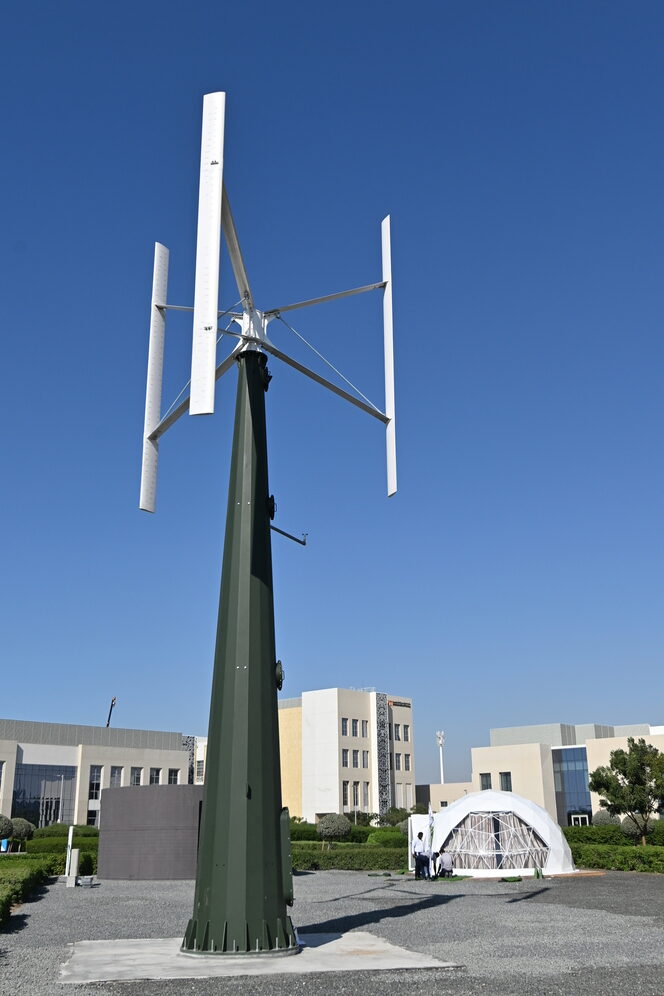
The vertical axis turbines allow to fully exploit the force of the wind in all its directions, thus differentiating themselves from the horizontal axis turbines which can instead exploit the wind arriving from a narrow angle.
In addition to being particularly silent, they allow for a lower environmental impact.
Ecolibri turbines are MADE IN ITALY. Designed and manufactured at our company.
In addition to normal operation in parallel with the network, Ecolibri turbines also allow the creation of off-grid HYBRID SYSTEMS by exploiting different energy sources (wind, sun and any other energy source).
Specification
The key feature of the wind turbine ECOLIBRI’ is to have an environmental impact which is completely irrelevant, even in the context of some wind turbines in a same place.
The shape, unique in its kind, makes the turbines minimally invasive both for their small size and for the chance to be painted with colours that reflect the surrounding environment.
Energy Solution
Ecolibrì offers the best personalized energy solutions.
Our story begins in 2016 when the first Ecolibrì 3.5kW vertical axis turbine was designed and built; a machine suitable for domestic use that required a small space to install it. Able to provide electricity for a medium-sized home, especially in remote areas, it could be combined with 2. kW of solar panels for the construction of a hybrid system.
Thanks to the experience gained with this first model of wind turbine, our engineering pool was then able to design the new 10kW & 20kW versions to be released soon.
Ecolibrì 10kW & 20kW vertical axis wind turbines are designed for use in areas where the installation of large horizontal axis turbines is not convenient / feasible.
Parallel Network (CEI 0-21)
The turbine is connected to the national electricity grid and the energy produced is fed into the grid and used according to the load to which it is connected.
Island system
Where the grid is not available, Ecolibrì hybrid systems made from 10kW & 20kW vertical axis wind turbines, solar panels managed by a single electrical panel and lithium batteries, can vary in terms of power and can be integrated with other types of generation. of electricity. The batteries allow the accumulation of the energy produced making it available 24 hours a day.
Components
Which are the components of wind turbine VAWT?
Blade and rotor assembly
Electric management panel
Support pole
Foundation plinth in reinforced concrete
Turbine Development And Installation
Faq
On grid and off grid wind turbines
Hybrid systems to manage more than energy sources
Average wind speed above 5 m/s with Weibull K distribution factor ≤ 2;
Site exposed to predominant winds with no obstacles higher than 10 m;
No specific site restrictions (landscape, geological, environmental)
Easy access for heavy vehicles;
• Verify that there are no legal restrictions
• Carry out an anemometric analysis lasting at least six months;
• Check the accessibility for heavy vehicles to the place of installation and related permits;
• Check the space required to mount the wind turbine;
The aforementioned elements affect the cost of the system and consequently the investment payback
In order to understand if a site can host a wind installation, the wind data have to be retrieved from:
airports;
harbours;
weather stations;
anemometric campaign.
How do I position the anemometer?
The anemometric station must be positioned where the turbine will be installed. At this point, it is essential to check the site in order to avoid possible wind turbulences caused by the morphology of the terrain.
The anemometer must be placed on a 10m high pole. It cannot be installed on a building. 220V mains current or, alternatively, an adequate storage system must be present.
GSM coverage must be present
The control unit should preferably be installed in a sheltered place
Rooftop installations are more complex than ground ones. During the project evaluation you need to consider the following factors:
• maximum load that the roof can bear;
• main wind direction;
In the case of installation on the roof, a structure that distributes the lateral forces (pressure, torsion and weight) because most of the time the frequency of the building is unknown
The calculations must be done in accordance with:
The rules of each Country
Geological report of the installation area
Ecolibrì standard plinth is calculated according to the IEC 61400-2 “Wind Turbines – Part 2: Design requirements for small wind turbines” international norm.
Turbine positioning is very important in order to guarantee maximum efficiency in energy production. If the turbines face the wind the distance between them must be at least three times the turbine diameter
Ecolibri technicians will analyze collected data so that it will be possible to define if it is convenient to install a wind turbine.
Attention: wind intensity and distribution may vary from year to year